Fusion energy represents one of the most ambitious engineering challenges of our time. Turning plasma physics into stable, long-term power generation requires not only scientific breakthroughs, but also highly advanced systems capable of operating in extreme radioactive environments.
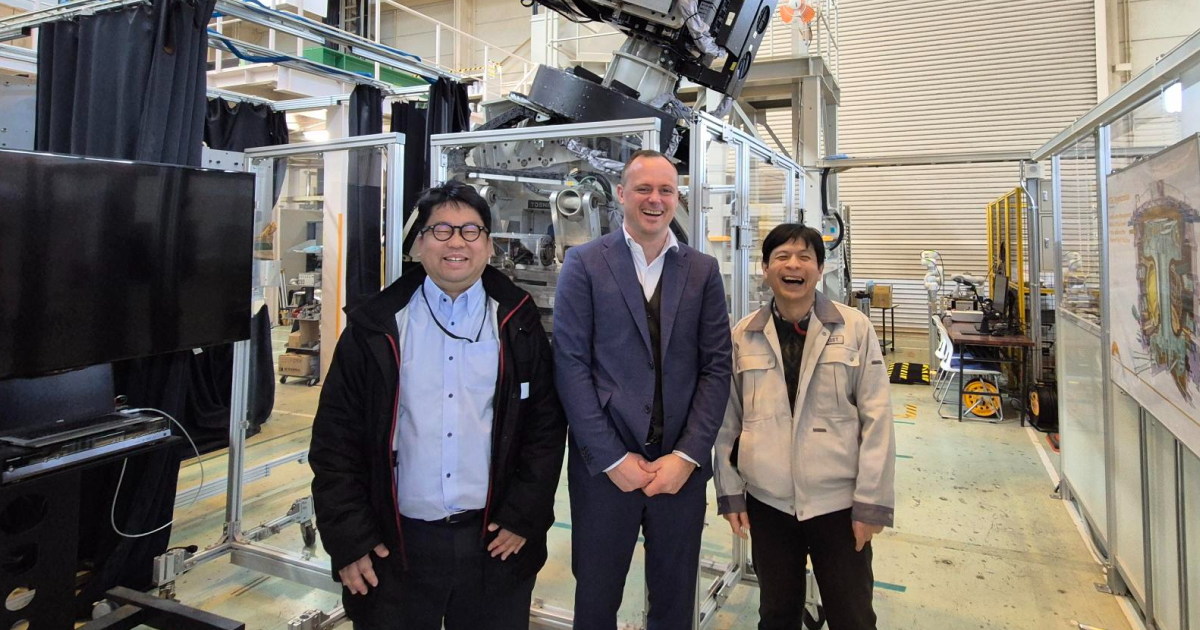
Last week, Magics’ CEO Jens Verbeeck visited the National Institutes for Quantum Science and Technology (QST) in Japan, a leading institution in fusion engineering and a major contributor to the international ITER project.
Remote Handling: Maintaining the Unreachable
Inside a fusion reactor, radiation levels prevent direct human intervention. Maintenance and assembly must therefore be performed remotely using highly specialized robotic systems known as Remote Handling (RH) technologies.
QST plays a central role in this field. The institute leads the development of advanced RH systems designed to ensure safe and reliable reactor operation. One of its flagship developments is the Blanket Remote Handling System (BRHS), a large-scale robotic platform responsible for installing and maintaining the massive blanket modules that line the reactor walls.
These blanket modules protect the reactor structure and capture energy from fusion reactions. Servicing them requires extreme precision, reliability, and coordination across mechanical, electrical, and control systems.
Magics’ Role: Enabling Reliability Where Failure Is Not an Option
Magics contributes to this effort by supplying critical electronics for the Instrumentation and Control (I&C) systems of the BRHS. These systems act as the nervous system of the platform, ensuring accurate positioning, monitoring, and safe operation in harsh radiation environments.
High-reliability electronics are essential in such applications. Systems must operate for extended periods without human intervention while withstanding radiation exposure that would rapidly degrade conventional components.
By developing radiation-tolerant semiconductor solutions, Magics helps enable the safe digitalization of complex nuclear systems, supporting automation, precision control, and long-term operational reliability.
A Thriving Fusion Ecosystem
The visit highlighted the strength of Japan’s fusion engineering ecosystem. Laboratories, robotics platforms, and integration facilities demonstrate how interdisciplinary collaboration drives progress in fusion technology.
The scale and sophistication of the systems leave a strong impression. As Jens Verbeeck reflected during the visit: “This is art, isn’t it?”
Behind that statement lies an appreciation for the precision engineering, coordination, and craftsmanship required to build systems that operate in some of the most extreme conditions on Earth.
Supporting the Energy Systems of Tomorrow
Fusion energy promises abundant, carbon-free power. Achieving it requires global collaboration and contributions from specialists across electronics, robotics, materials science, and systems engineering.
Magics is proud to support partners such as QST in advancing this mission, providing the reliable electronics that allow complex machines to operate safely and precisely.
Because the path to fusion is built not only on scientific discovery, but on the engineering that turns theory into working systems.