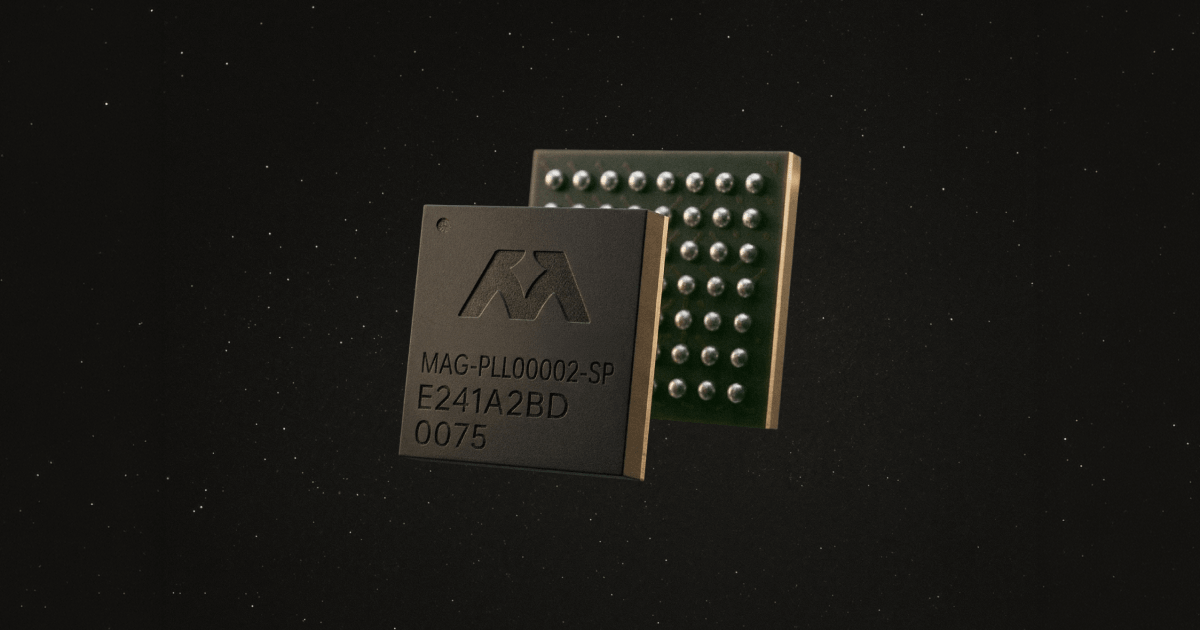
Understanding the Role of the MAG-PLL00002
1. Introduction
Clock signals define the temporal structure of an electronic system. They determine when data is sampled, when signals propagate, and how subsystems remain synchronized. While often treated as a supporting function, clock stability and distribution directly impact system performance, particularly in architectures where multiple domains must operate coherently.
In high-reliability environments such as space systems, this role becomes more critical. Components must maintain predictable behavior under radiation exposure and over long mission durations, while enabling system-level supervision and fault detection. Monitoring capabilities, such as PLL lock status, allow systems to detect anomalies and react accordingly, reducing reliance on direct intervention and supporting robust operation in constrained environments.
2. Fundamentals of PLL-Based Clock Generation
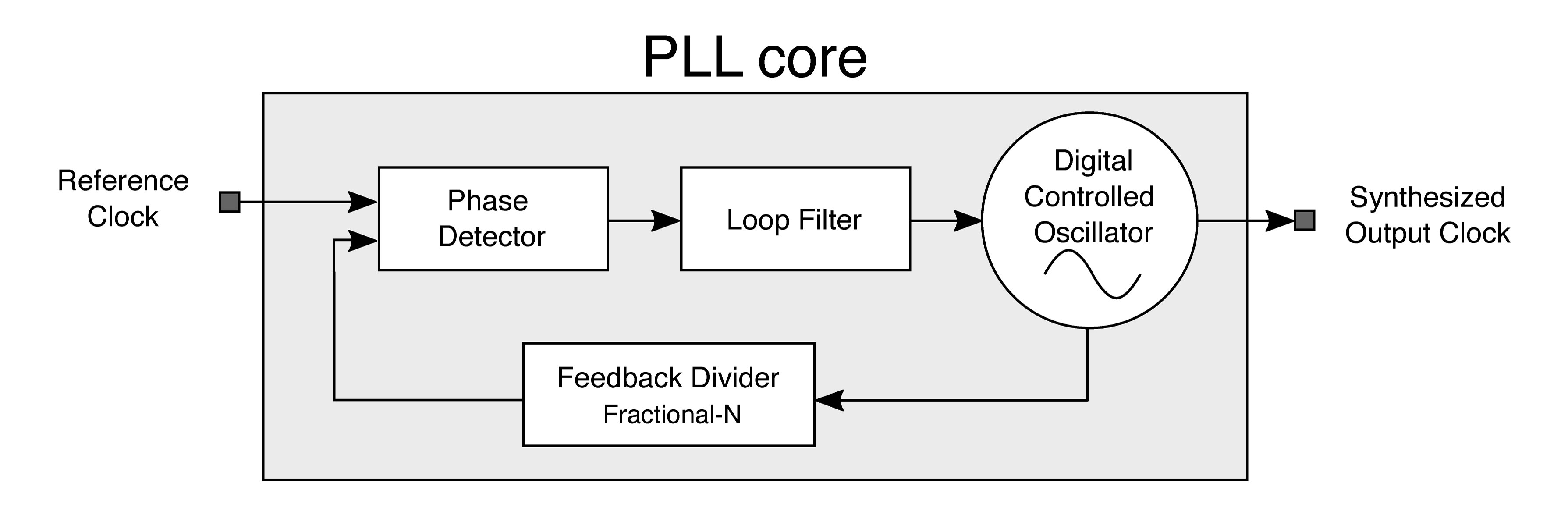
At the core of most clock generation systems is the phase-locked loop (PLL), a closed-loop control system that aligns the phase and frequency of an internally generated signal with an external reference.
In a fractional-N architecture, such as the one implemented in the MAG-PLL00002, the output frequency is derived from the reference with fine granularity. The device accepts an external reference in the range of 10 to 100 MHz and generates output frequencies from 1 MHz up to 5 GHz using an internal oscillator.
The phase detector continuously compares the reference signal with a feedback signal derived from the output. Any phase error is corrected through the loop filter until the system converges to a stable state.
3. Clock Distribution and Phase Coherence
Generating a stable clock is only part of the system requirement. The clock must be distributed across multiple subsystems, each requiring its own signal levels and interfaces, while maintaining controlled and deterministic timing relationships. While some level of skew between outputs is unavoidable, ensuring that this skew remains constant and predictable is essential for coherent system operation.
The MAG-PLL00002 integrates multiple differential outputs, including four multi-standard channels below 1 GHz and two RF outputs, all derived from a common PLL core. While each output can be configured independently, they remain phase-related through the same reference. Selected outputs can be phase-aligned, allowing users to define synchronization groups according to system requirements and maintain deterministic timing across channels.

4. Performance Considerations: Phase Noise and Jitter
Clock quality is evaluated in both frequency and time domains. Phase noise characterizes spectral purity, while jitter describes short-term variations in clock edge timing.
The MAG-PLL00002 achieves a normalized phase noise of –223 dBc/Hz. At a 4.0 GHz carrier, it exhibits a phase noise of –120 dBc/Hz at a 1 MHz offset. In the time domain, jitter performance on the order of 170 fs is achieved at this frequency.
These parameters directly impact system-level performance in high-speed and precision applications.


5. Operation in Radiation Environments
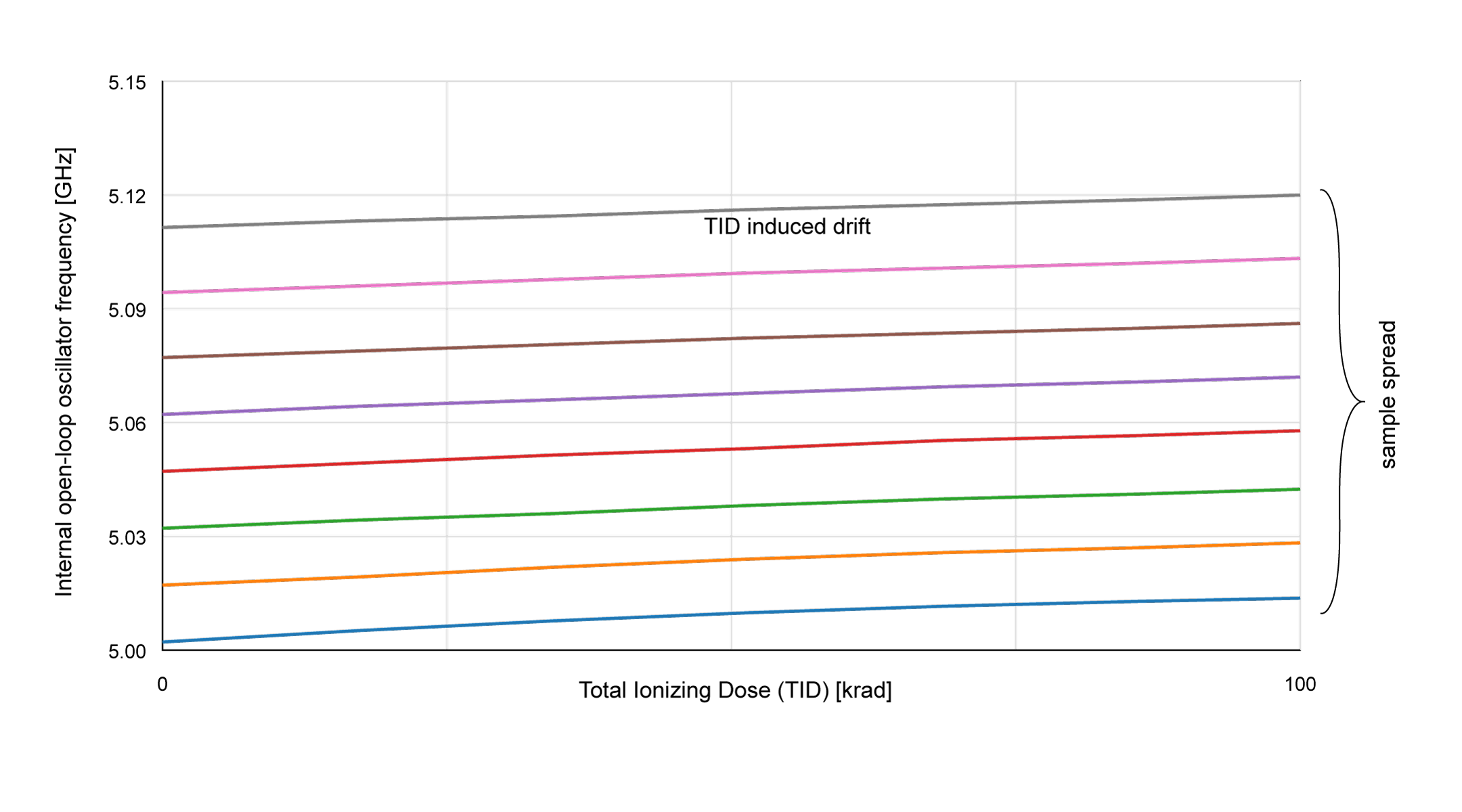
In radiation environments, degradation mechanisms such as Total Ionizing Dose (TID) and Single Event Effects (SEE) must be considered. TID leads to gradual parameter drift, while SEE can introduce transient disturbances.
The MAG-PLL00002 is designed to operate up to 100 krad (1 kGy) TID, maintaining functional stability over time. The design approach focuses on ensuring that key performance characteristics remain within controlled and predictable bounds across the mission lifecycle, rather than optimizing for nominal conditions alone. This is critical in applications where long-term reliability and consistent behavior under radiation exposure are required.
6. Integration and System Considerations
From a system integration perspective, practical features determine overall usability and robustness. The device includes an SPI interface for configuration and control, enabling flexible adjustment of operating parameters within the system.
PLL lock monitoring provides visibility into the operational state of the loop, while additional monitoring capabilities such as reference clock presence detection and on-chip temperature sensing support system-level supervision. Interrupt flag generation allows external controllers to react to events such as loss of lock or reference anomalies. The device achieves lock in less than 700 µs under worst-case conditions, enabling fast startup and predictable behavior during system initialization. Together, these features reduce integration complexity and support reliable operation without requiring extensive external circuitry.

7. Conclusion
Clock generation is a mature domain, and PLL-based solutions are widely available. However, in high-reliability environments, the challenge shifts from achieving peak performance to ensuring stable operation under constraints, predictable long-term behavior, and straightforward integration.
The MAG-PLL00002 addresses these requirements by providing a radiation-tolerant, configurable clock generation and distribution solution. Its value lies in enabling engineers to implement reliable timing architectures with reduced integration risk, supporting system performance where timing is a critical dependency.
To learn more about the MAG-PLL00002, request the product datasheet, or explore our full product portfolio, please contact our team.