As part of the ANUBIS project, SCK CEN and MAGICS Technologies joined forces once again, this time to tackle a bottleneck that sits at the very end of every nuclear dismantling project: proving a building is clean. The result is O.S.C.A.R. (Optimised System for Contamination Assessment and Reporting), a smart add-on that turns any handheld contamination monitor into a self-logging measurement device.
The challenge
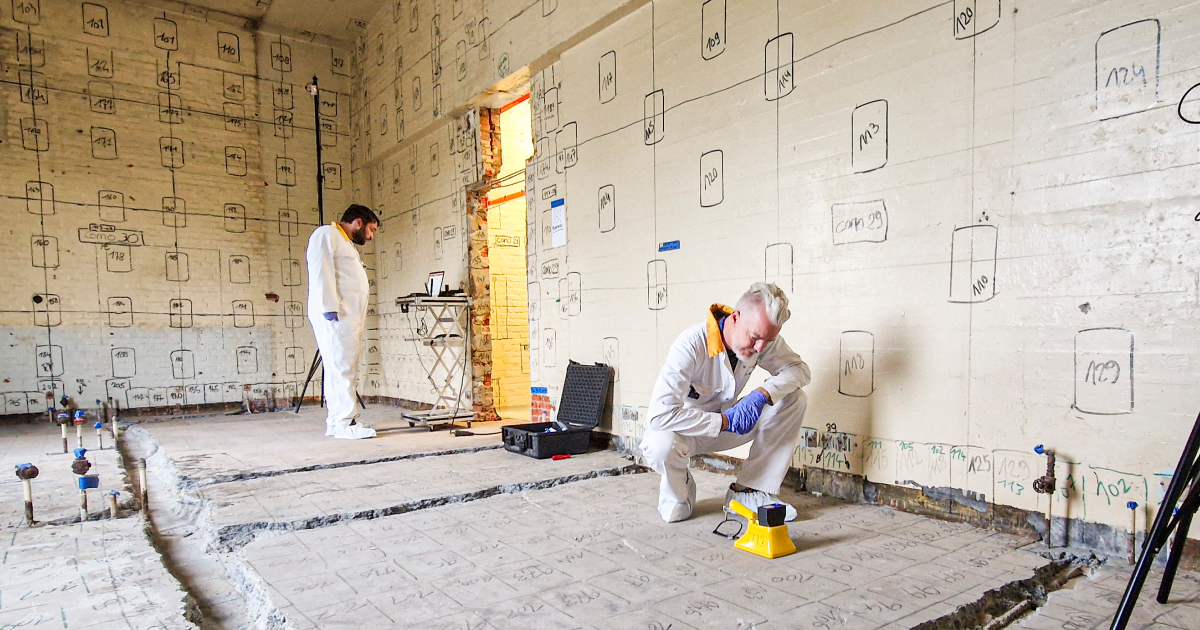
Before a nuclear facility can be demolished, every wall, floor and ceiling has to be checked and cleared of contamination above the permitted limits. Today, that clearance work is almost entirely manual: an operator walks a grid of the room, takes a reading at each square metre with a handheld monitor, and then transcribes every value (and its location) into a spreadsheet by hand.
It's a process that can involve thousands of individual readings per room, and each one carries a small risk of being logged against the wrong square, mistyped, or simply forgotten. Beyond the time it costs, that manual bookkeeping step is where regulatory traceability is most at risk.
At the same time, fully automated, robotic scanning solutions exist, but they tend to struggle with real-world edge cases and typically need a detailed 3D model of the space up front, which adds cost and setup time that isn't always justified for a site that will only be measured once.
The solution: O.S.C.A.R.
Rather than replacing the handheld monitor or building a new robot, SCK CEN and MAGICS designed O.S.C.A.R. as an add-on: a small module that clips onto the measuring device an operator already knows how to use.
The add-on combines two things the manual process was missing: automatic reading and automatic positioning.
- A camera subsystem photographs the monitor's display, so the contamination value never has to be typed in by hand.
- A real-time localisation module tracks the add-on's position in the room to centimetre-level accuracy, so every reading is automatically tied to the exact (x, y, z) location where it was taken.
Both data streams are aggregated on the add-on itself and sent wirelessly to a local backend, which stores the measurements, runs the OCR and localisation calculations, and exposes the results through a dashboard and API for export and reporting.
How it works
Ahead of a measurement campaign, the room is fitted with a handful of wireless anchors that enable indoor positioning. From there, the workflow barely changes for the operator: they use the same handheld monitor as always, now paired with the O.S.C.A.R. module. Triggering a measurement starts both the monitor and the add-on together, and once the integration time has elapsed, the add-on photographs the display and gathers the anchor distance data, then sends both to the backend, which reads the value via OCR and calculates exactly where in the room that reading was taken.
The result and its location are sent to the backend in real time and shown back on the add-on's small display, giving the operator instant visual confirmation that the reading was captured correctly before moving to the next spot.
What makes O.S.C.A.R. different
The strength of O.S.C.A.R. is that it makes existing equipment smarter instead of replacing it. Because the add-on is designed to mount and unmount without any permanent modification to the monitor, organisations keep using the devices, and workflows, their teams are already trained on.
That same philosophy extends to compatibility: O.S.C.A.R. is designed to work across handheld monitors from different manufacturers, including Berthold and Nuvia, avoiding lock-in to a single device vendor. Its modular architecture also leaves room to extend the system to other measuring devices and use cases in the future.
Operators can take thousands of measurements per room, and each one has to be linked to the right spot by hand; a task Brecht Deblier, characterisation expert at SCK CEN, describes as "labour-intensive." Automating that link is what makes the clearance process both faster and more reliable.
Siebe Vervoort, Electronics Engineer at MAGICS Technologies and lead designer of the add-on, sums it up simply: digitalising the process improves "both the efficiency and the quality" of the data operators collect.
Faster measurements, fewer errors, better traceability
By removing manual transcription from the process, O.S.C.A.R. cuts down the administrative burden on operators and reduces the risk of human error, while making measurement data reproducible and consistent from room to room. Every reading is automatically and precisely linked to its location, creating a clear digital audit trail; exactly what's needed for internal quality control and regulatory reporting during decommissioning.
ANUBIS: Belgium's innovation hub for nuclear dismantling
O.S.C.A.R. is one of several technologies developed under ANUBIS ("Advancing NUclear dismantling in Belgium through Improving Sustainability"), a project awarded EU recovery-and-resilience funding to SCK CEN in 2021. ANUBIS aims to build the technology and expertise needed to reuse materials released during nuclear dismantling as cost-efficiently and sustainably as possible, work that directly supports the planned dismantling of the Doel and Tihange nuclear power plants. MAGICS is one of several private-sector partners contributing to the project, alongside earlier ANUBIS collaborations such as a radiation-hardened camera system for inspection in high-radiation zones.
Want to know more? Read about O.S.C.A.R. on the SCK CEN website, and discover the ANUBIS project.
Header Image ©: SCK CEN